Photo: Google Gemini · AI-generated
New to this topic? Start here
Terms used in this piece
- Decision model
- A model that does not write text. It gets a situation and a fixed list of possible answers, and gives each answer a probability.
- Classification
- Sorting an item into one of a few known categories, such as which team a support ticket belongs to.
- Confidence score
- The probability a model gives its own answer. A score of 0.9 means the model expects to be right about nine times in ten.
- Calibration
- Whether those scores can be trusted. A well-calibrated model that says 90% is in fact right about 90% of the time.
- Threshold
- The confidence level you choose. Above it the software acts on its own; below it a person decides.
Read first
- Thresholds and the confusion matrix ↗A short module from Google's free machine learning course. The clearest explanation we know of why a threshold is a choice you make, not a setting the vendor gives you.
- Agentic Coding in Production: Where We Let AI Drive, and Where It StopsHow we build checkpoints into an AI-assisted workflow. This piece builds on it.
A support ticket comes in, and someone decides whether it belongs to billing, the warehouse or IT. A supplier’s delivery note arrives, and someone checks whether it matches the order. A form is submitted, and someone decides whether it is complete enough to process.
None of this needs a model that writes. Each case needs one answer from a short, fixed list. When a mid-sized company tells us it wants “AI in the process”, this is very often what it means, and it is a different job from the chat assistant everyone pictures.
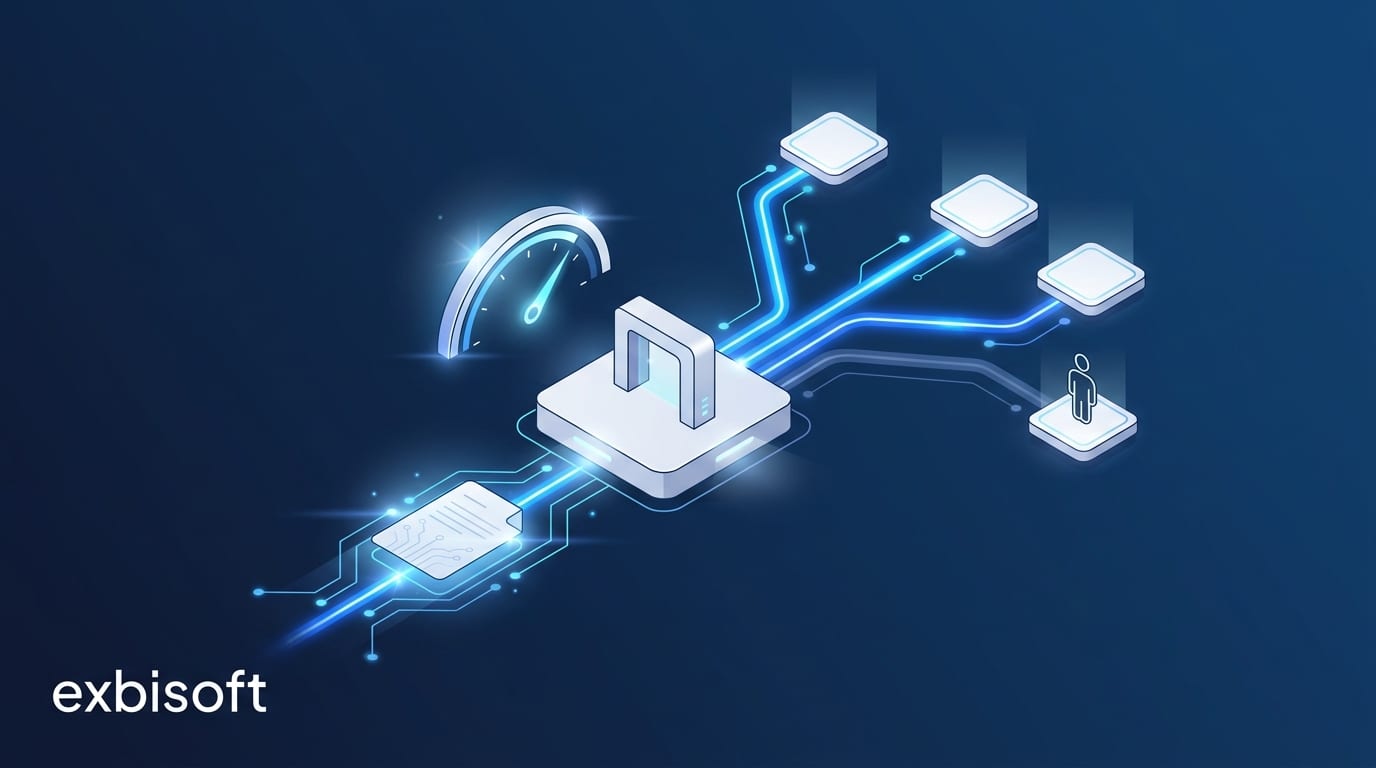
On 9 October Microsoft released a model built for that job. Microsoft-Decision-1 takes a situation and a fixed set of options and returns a probability for each one, in a single call. It is a post-trained version of the open Qwen3.5-9B model, it costs $0.042 per million input tokens with output free, and by Microsoft’s own measurement it answers about 35 times faster at the median than the large general model it was compared with.
The number worth paying attention to
Speed and price are what the announcement leads with. The part we find more useful is a sentence further down: a 90% prediction should be right about nine times out of ten.
If that holds, the design of an AI step changes. You no longer ask “can we trust the model?” in general. You pick a threshold. Above it, the system acts on its own. Below it, a person decides. “Human in the loop” stops being a slogan and becomes a setting with a number, and someone in the company has to choose that number and be able to explain it.
Whether it holds for your data is something you can find out in an afternoon rather than a project. Take a few hundred past cases where you already know the right answer, run them through the model, and group the results by confidence. If the cases scored around 90% are right only three times in four, the vendor’s calibration does not carry over to your work, and your threshold has to move. Microsoft also reports how often the model changes its answer when the same request is reworded or the options are shuffled: 1.3% on average. That test is just as easy to repeat on your own cases, and we would not set a threshold without it.
Before you reach for a model at all
Here we disagree a little with the excitement around the launch. Many of these decisions do not need a model.
This website and our LinkedIn posts are produced with an AI agent, as we described earlier. The checks that stop a post before it goes out are not AI. They are a script with a list of rules: is the alt text there, is the hook short enough, does the text use a phrase we have banned. It says pass or fail, it costs nothing, it never drifts, and anyone can read exactly why it said no. Since this month every post also waits for a person to approve it, which no model replaces.
A model earns its place where the input is messy: free text, a hundred ways of phrasing the same complaint, a scanned document that never looks the same twice. “Is the invoice number filled in” is a rule. “Which team should read this email” is a model. Most real processes are a mix, and the sensible order is rule first, model for what the rules cannot decide, person for what the model is unsure about.
Where the call runs, and whose numbers these are
The model is available through Microsoft Foundry and OpenRouter. For a client whose data must stay in the EU, that is not one answer but two: ask which region the Foundry deployment runs in, and through OpenRouter, which provider actually serves the request. We wrote about this question at length in our piece on where your data lives.
The benchmarks are Microsoft’s own: 36 benchmarks, competitors chosen by Microsoft, and an editor’s note that the post was updated after publication to add more results. None of that makes the numbers wrong. It makes them a starting point, which is why the afternoon of testing matters more than the launch chart.
We have not used a decision model on a client project yet. When we do, we will start with exactly that test, and we will write down the threshold and who chose it. If your team spends its day choosing between three options for every incoming item, we would like to hear about it: talk to us.
Go further
- Probability calibration ↗The technical background to the afternoon test described above, including how to draw a calibration curve from your own cases.
- GDPR Is Table Stakes. Where Your Data Lives Is the New Question.Why the region and the provider behind an AI call matter for EU clients.
Sources
- Microsoft-Decision-1 documentation, Microsoft LearnHow the model is called and what it returns.
- Microsoft-Decision-1 in the Foundry model catalog, Microsoft
- Microsoft puts a 9B decision model in Foundry for agent workflows, RuntimeWireIndependent coverage of the launch, including the base model and pricing.