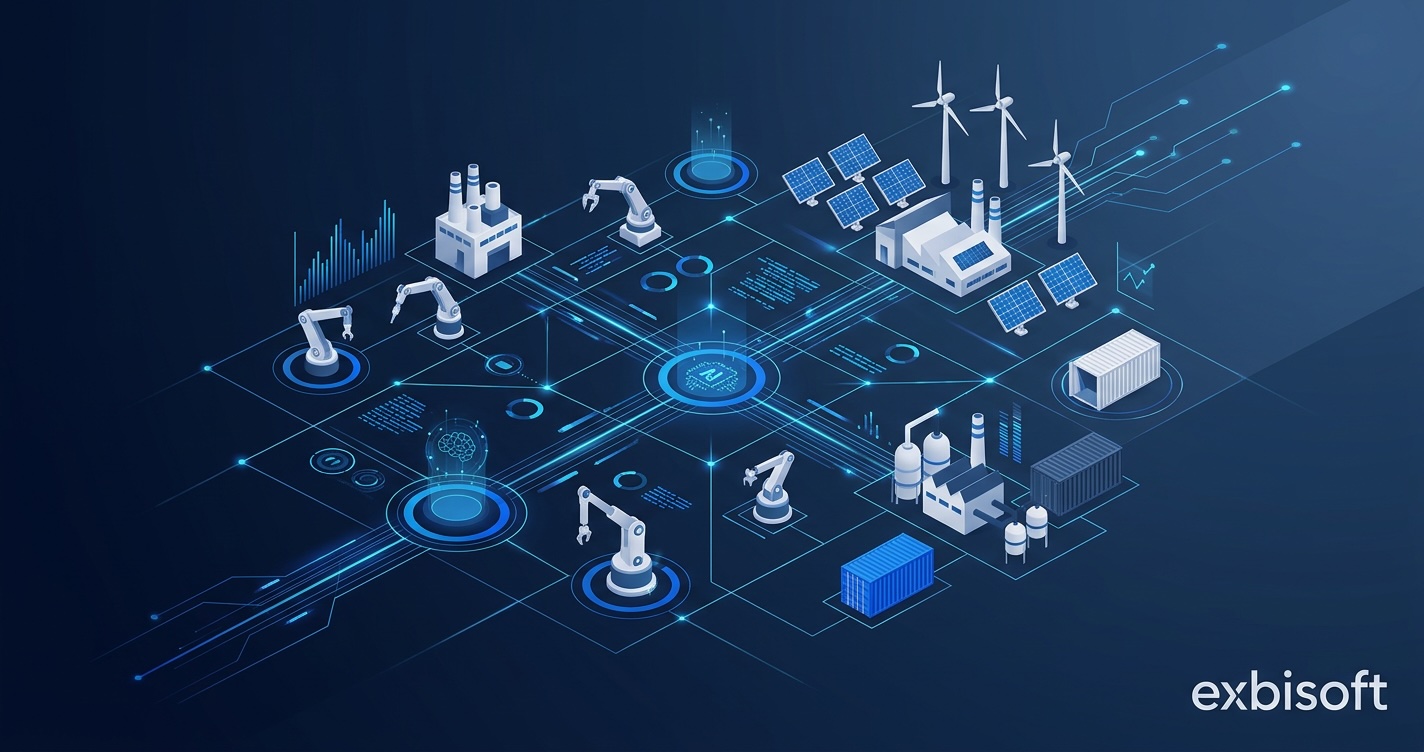
Photo: Google Gemini · AI-generated
The conversation around AI in manufacturing has been running for years. Most of it has been noise. What is changing now is that the noise is giving way to actual production deployments — and the gap between the use cases that work and the ones that do not is becoming clearer.
What is working
Anomaly detection on production line sensor data is genuinely useful, even with modest datasets. You do not need millions of records to build a model that flags unusual vibration patterns on a CNC spindle. A well-trained model on six months of shift data can outperform human monitoring at 3am on a Friday.
Predictive maintenance is the headline use case for a reason: it delivers measurable ROI and the data is usually already there. The missing piece for most manufacturers is not the model — it is the pipeline. Getting sensor readings reliably into a format the model can consume, in near-real-time, across a plant with 30-year-old PLCs, is where the real engineering work lives.
Document intelligence — reading incoming orders, delivery notes, or technical specs — is a practical AI application that medium-sized companies are deploying right now. It does not require special infrastructure. It reduces manual entry errors and speeds up a genuinely painful process.
What is not working yet
Autonomous decision-making in production scheduling. The models exist, but the integration with existing ERP systems is messy, the liability question is unresolved, and plant managers do not trust it. That is not a technical problem — it is an adoption and governance problem that needs to be solved before the technology can be applied.
General-purpose chatbots bolted onto internal knowledge bases. The promise sounds good; the reality is a retrieval quality problem that most off-the-shelf implementations have not solved.
What this means if you are planning a project
Start with a problem that has clean data already attached to it. If the data does not exist or is not structured, build the data infrastructure first. An AI layer on top of dirty data produces confident wrong answers — which is worse than no AI at all.
Be specific about what the system needs to decide or flag, and what a human still needs to review. The most successful deployments keep humans in the loop for consequential decisions and use AI to reduce the volume of routine work that humans have to process.
The technology is ready for production in defined, bounded use cases. The integration work is still the hard part.