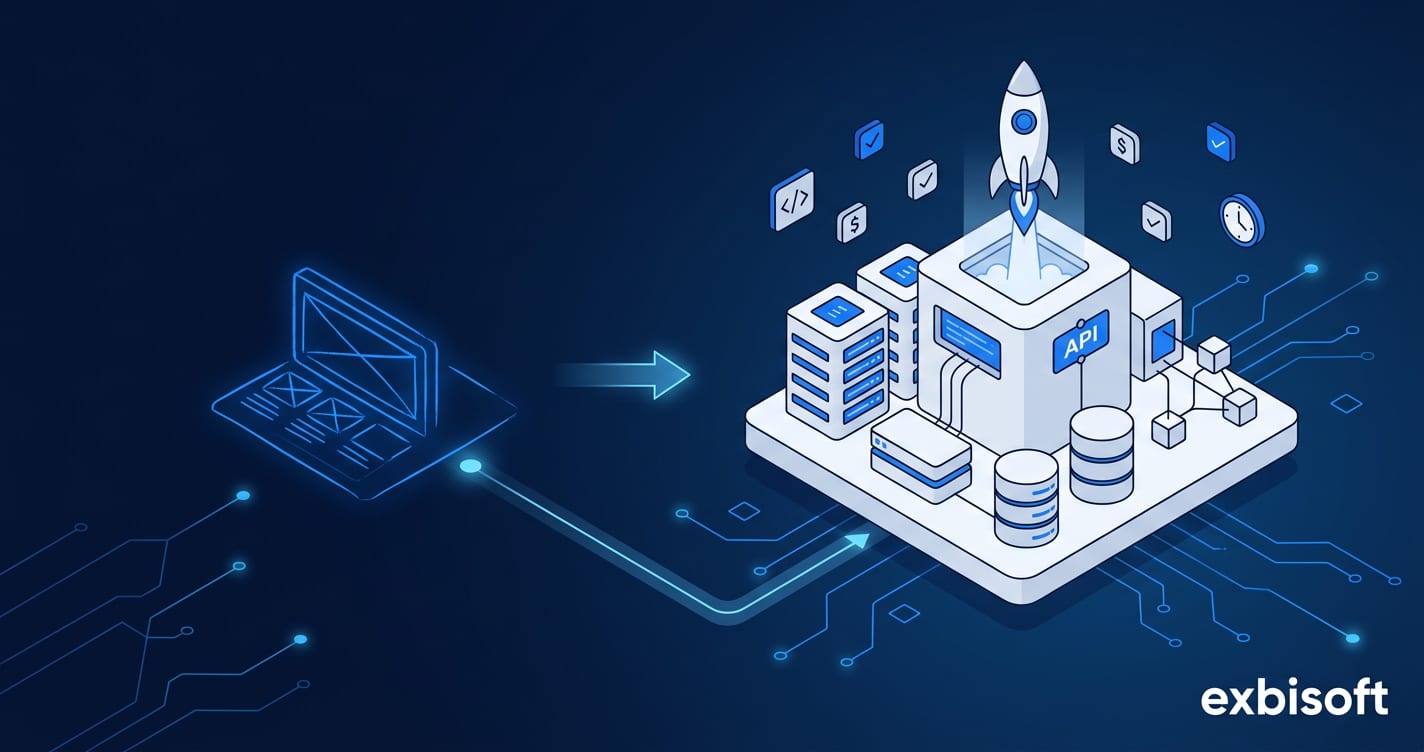
Photo: Google Gemini · AI-generated
A digital marketer from Greece built PrintPigeon — a working micro-SaaS product with payments, email, and backend — in three days using an AI coding tool. Total cost: $38 in platform credits. No development team. No technical co-founder. No months of planning.
Eighteen months ago, this would have been unbelievable. Today, it is just Tuesday.
A new world has opened
AI-assisted development has fundamentally changed what is possible for startups and solo entrepreneurs. Tools like Lovable, Cursor, Claude Code, and GitHub Copilot have collapsed the time and cost of building a first version of almost anything. Ideas that used to require a $50,000 seed budget and three months of agency work can now be prototyped in a weekend.
This is genuinely exciting. The barrier to testing an idea has never been lower. If you are a founder sitting on a concept — a workflow tool, a niche marketplace, a B2B utility — the excuse that “I can’t build it” no longer holds. You can validate demand before you write a business plan. You can show investors a working product instead of a slide deck.
The PrintPigeon story illustrates this perfectly. Yannis had a real problem — no printer, no post office, and a tax form that needed mailing. He built a solution, launched it, validated demand with £100 in Google Ads, then pivoted to organic SEO with programmatic landing pages. All with AI tools and no engineering background.
That is the power of the moment we are in.
The gap between prototype and product
But here is what the success stories rarely mention: the MVP is the easy part.
PrintPigeon works beautifully as a micro-SaaS for a solo operator. But the moment a startup takes funding, acquires real users at scale, handles sensitive data, or needs to integrate with enterprise systems, the rules change entirely.
A prototype built in three days typically has:
- No automated testing — so every change risks breaking something
- No security hardening — fine for a side project, dangerous for a funded company
- No architecture for scale — what works for 100 users collapses at 10,000
- No compliance consideration — GDPR, payment regulations, accessibility
- No maintainability — the AI generated it, but who debugs it at 2 AM when it breaks?
This is not a criticism of AI-built prototypes. It is a description of what happens when a startup succeeds and the prototype needs to become a product.
Build fast, then build right
The smartest approach for startups today is not “AI tools or a development team.” It is both, in sequence.
Phase 1: Validate fast. Use AI tools to build your MVP. Test demand. Get user feedback. Iterate on the concept. This is where speed matters and perfection does not.
Phase 2: Build for real. Once you have validation — paying users, investor interest, a clear market — bring in an experienced development team to rebuild or refactor the prototype into production-grade software. Proper architecture, testing, security, CI/CD, and the engineering discipline that keeps a product running as it scales.
Phase 3: Scale with support. As you move through funding stages — pre-seed to seed to Series A — your product needs to evolve. New features, new integrations, compliance requirements, performance under load. An agile team that knows your codebase and your domain grows with you.
Why exbisoft for this journey
We work with startups at exactly this inflection point. Our team uses the same AI tools — Claude Code, Cursor, GitHub Copilot — but we pair them with years of experience building production software that lasts.
We are agile, we are small enough to move fast, and we understand the modern toolchain. But we also know what a production system needs that a prototype does not: architecture decisions that scale, test coverage that prevents regressions, deployment pipelines that let you ship confidently, and code that someone can maintain three years from now.
The AI revolution has not made experienced developers obsolete. It has made them faster — and more valuable than ever for the work that comes after the MVP.
Build your prototype in three days. Then talk to a team that can help you turn it into a company.