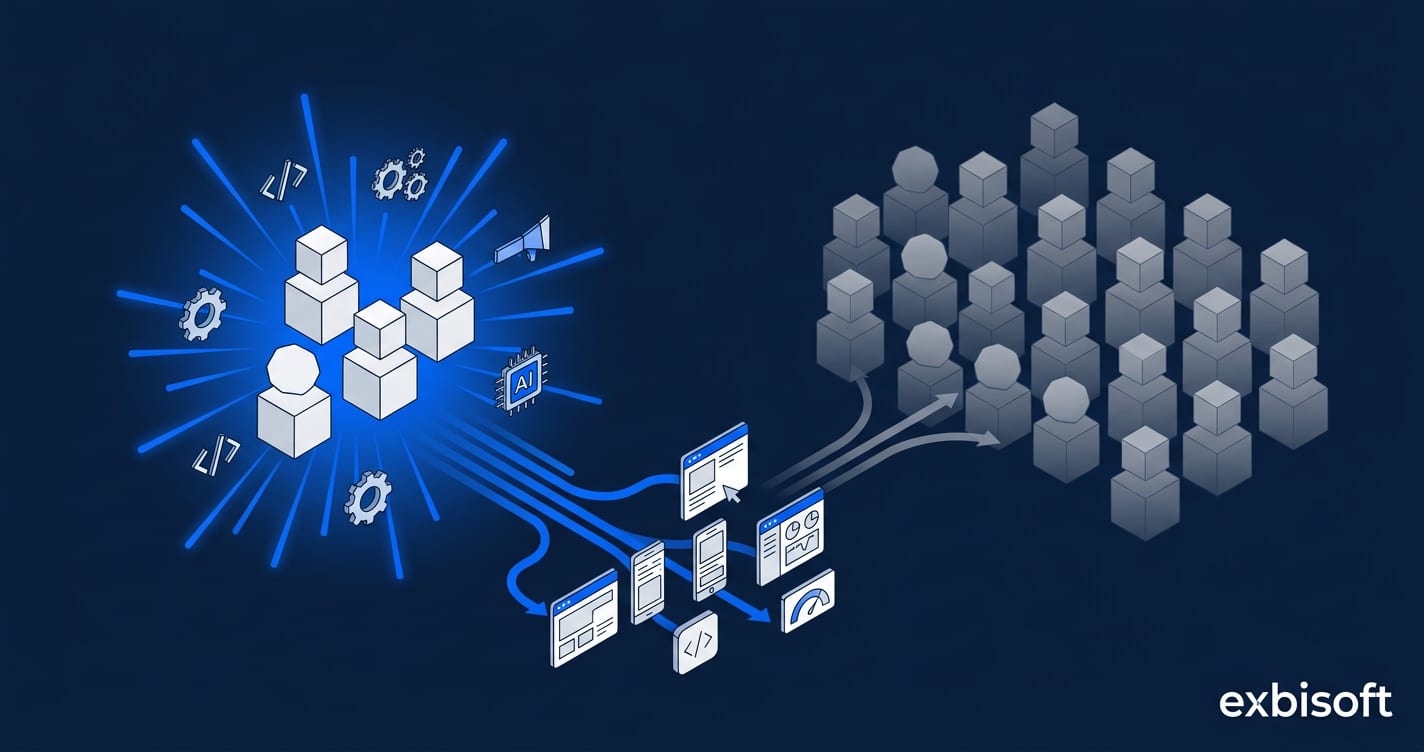
Photo: Google Gemini · AI-generated
A recent Forbes Business Council piece makes the argument plainly: the future of tech companies is output, not team size. The era of headcount economics — where a company’s capability was measured by how many engineers it employed — is ending. What matters now is what a team delivers, not how large it is.
The numbers behind this shift are significant. Tech layoffs in 2026 have passed 140,000, but not because companies are struggling. Profitable firms are reallocating budget from commoditised roles to AI infrastructure. Meta, Amazon, and Oracle are reducing engineering headcount while increasing output. Studies report productivity gains of 26% in software development and 50% in marketing. Tasks that required a team of twenty are being accomplished by a team of eight — not as a prediction, but as what companies are reporting in earnings calls.
This is not news to us
At exbisoft, we have never competed on headcount. We are a lean studio — a small, senior team that builds and operates custom software for mid-sized businesses. We have always believed that a focused team with deep expertise delivers more than a large team with shallow coverage. The AI tools emerging now do not change that conviction. They amplify it.
What has changed is the toolset. Our engineers now work with AI-assisted development environments that handle boilerplate, accelerate code review, generate test scaffolding, and surface patterns across codebases faster than manual search ever could. This does not replace engineering judgement — it removes the mechanical work that used to consume time better spent on architecture, business logic, and the decisions that actually determine whether software succeeds.
Output per engineer is the metric that matters
The Forbes article frames this as a macro trend reshaping tech companies. We see it more concretely: it is the difference between a client paying for a team of twelve to build a system over eighteen months, and a team of five building the same system in eight — with better test coverage, more consistent code quality, and faster iteration cycles.
For our clients in precision machinery, medical technology, and construction, this matters directly. These are companies where software budgets are scrutinised, timelines are tied to business cycles, and the expectation is delivery, not process theatre. They do not care how many people are on the team. They care whether the purchasing portal connects to Sage 100 correctly, whether the labelling system produces UDI-compliant output, and whether the mobile app works reliably on a construction site with intermittent connectivity.
AI-enabled, not AI-replaced
The distinction that matters is between companies replacing people with AI and companies enabling people with AI. The layoff numbers make headlines, but the more interesting story is what happens inside teams that adopt AI tools without shrinking — teams where the same people produce substantially more.
That is the path we are on. Our core team is not being replaced by AI. It is being equipped with tools that extend what each engineer can deliver. A senior developer who previously spent 30% of their time on mechanical tasks now spends that time on the work that requires human judgement — understanding the client’s business, designing for edge cases the specification did not anticipate, and making architectural decisions that will hold up over years of operation.
What this means for our clients
If you are evaluating software partners, the question is no longer “how large is your team?” It is “what can your team deliver, and how fast?” A company with 200 engineers and no AI tooling may deliver less per quarter than a company with 15 engineers and a mature AI-enabled workflow.
We are not making a theoretical argument. We are building production systems for clients across industries — ERP platforms, compliance tools, integration layers, mobile applications — with a team that would have been considered too small for this scope five years ago. The output says otherwise.
The end of headcount economics is not a threat to studios like exbisoft. It is the operating model we have been building toward.