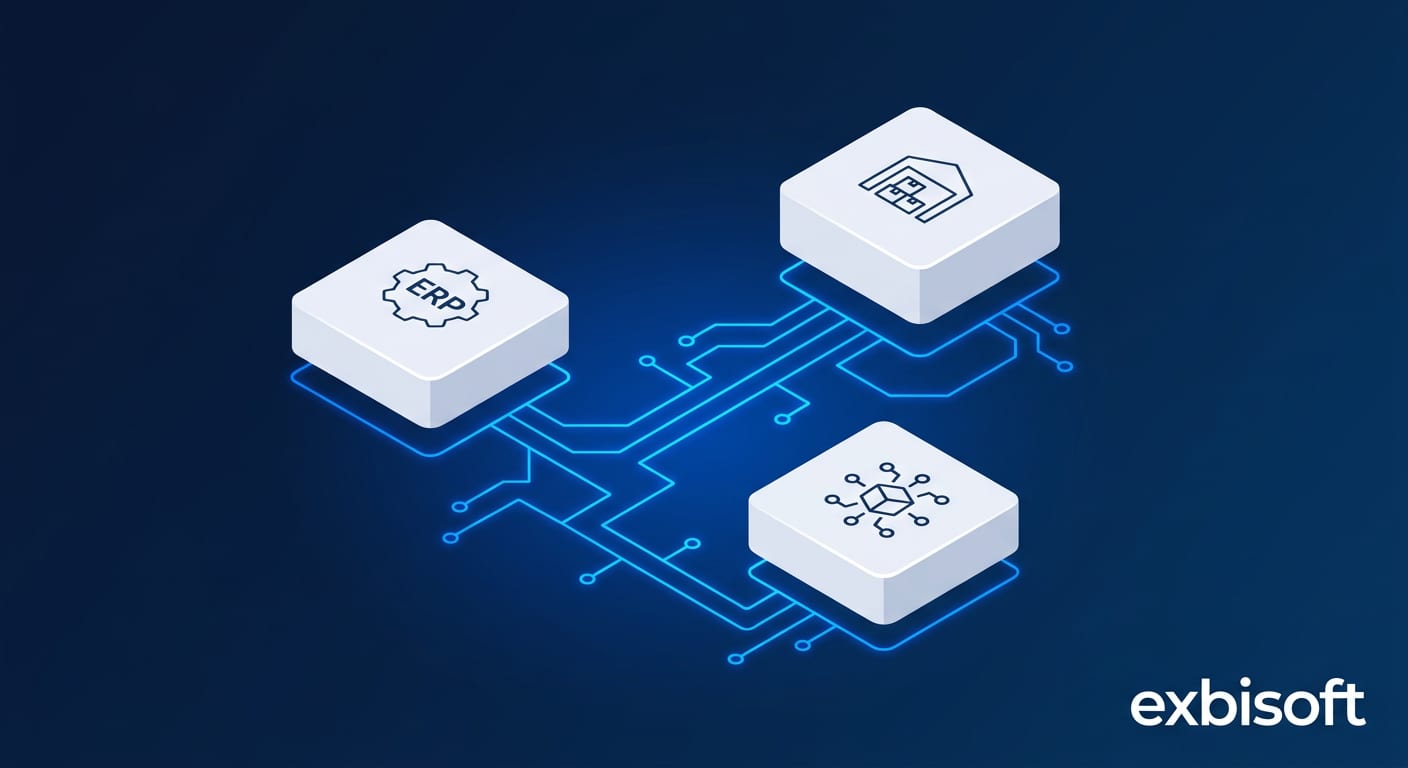
Photo: Google Gemini · AI-generated
Every few months, a new multi-enterprise network promises to connect manufacturers with their suppliers, warehouses, and customers through standardized EDI transactions. The pitch is compelling: plug into the network, and your ERP, WMS, and TMS suddenly talk to everyone else’s. For manufacturers running a high volume of standardized trading relationships, that value is real.
But for most of the manufacturers we work with — in industrial machinery, luxury and fashion, chemicals, and automotive — the actual blocker sits one level lower, before any EDI transaction is worth exchanging: their own internal systems don’t reliably talk to each other yet.
The bottleneck sits before the network
EDI networks assume a coherent stack on each end — an ERP, a WMS, a TMS, all ready to send and receive standardized documents. Mid-sized manufacturers rarely start from that position. A garment manufacturer’s inventory system doesn’t share a product identifier scheme with the platform tracking its sales. A retail kiosk network has no native connection to the SAP backend recording every transaction behind it. A purchasing team’s ERP handles finance and inventory competently but has no purchasing workflow at all.
None of that is an EDI problem. It’s an integration-engineering problem, and it has to be solved before a network connection — or any external data exchange — produces trustworthy data on either end.
Heterogeneity is the default, not the exception
Talk to enough manufacturers and a pattern emerges: the ERP was chosen for finance, the WMS was chosen (or built) for the warehouse team’s specific workflow, and the PLM tool — if one exists at all — was adopted by product or engineering years later, often after an acquisition. None of these systems were selected with each other in mind. Each is correct in isolation and disconnected from the others.
This shows up differently by sector. In garment and fashion manufacturing, it’s SKU and variant mismatches — the same product represented under different identifiers, sizes, and colours across inventory, sales, and fulfilment systems. In industrial machinery, it’s an ERP that never had a purchasing or vendor-management module, so sourcing runs on spreadsheets instead. In chemicals, it’s field-collected compliance data that has to reach a system of record with an audit trail intact. In automotive supply chains, the same shape of problem appears in bill-of-materials and PLM data that needs to flow cleanly into ERP and WMS across multiple supplier tiers. Different industries, same underlying issue: heterogeneous systems that were never built to interoperate.
What this looks like in practice
We’ve built this integration layer as custom software, not as a subscription to somebody else’s network, because the actual mismatch in each case was specific enough that a generic connector wouldn’t have closed it. A Purchasing Portal extended a manufacturer’s existing Sage 100 ERP with a purpose-built purchasing workflow for a global vendor network — order status, shipment updates, and delivery data flowing back into the ERP automatically, with no re-entry. A Supply-Chain Intelligence Platform sits between Zoho Inventory and Sellerboard for a garment manufacturer, resolving SKU and variant mismatches and giving management a single, reconciled view of stock and profitability that neither system could produce alone. A Mobile Kiosk App for a jewelry manufacturer connects to an existing SAP middleware layer across 500+ retail touchpoints in Europe, without touching the backend. A Visitor Compliance App integrates through custom middleware with a manufacturer’s existing visitor management system across multiple sites. ReportSync syncs field-collected reports over a secure tunnel into a CRM, with logging and retry, so nothing gets lost between the point of data capture and the system of record.
Buy the network once your own systems are ready to feed it
None of this is an argument against EDI networks or multi-enterprise platforms — for the standardized, high-volume trading relationships they’re built for, they earn their cost. It’s an argument for sequencing. Before shopping for a network layer, it’s worth auditing whether your own ERP, WMS, and PLM can actually produce clean, mapped, reconciled data in the first place. If the answer is no, that’s the project to run first — and it’s integration and custom software work, not a subscription.
Manufacturers who get this sequence right end up with systems that trust each other internally before they ever have to trust a partner’s system externally. That’s the harder problem, and it’s the one worth solving properly. Tell us what needs to connect — we’ll tell you honestly how much of it is integration work.