Photo: Google Gemini · AI-generated
Field software has a failure mode that office software does not: silence.
A field engineer finishes a report on site. They tap sync. The connection drops at that exact moment. The upload fails. Nobody sees it fail. The engineer drives to the next site. The office assumes the report arrived. It did not.
Weeks later, someone asks where the report is. Now it is a problem — and nobody can say when or why it disappeared.
In the field, bad connectivity is the normal case
Office software gets to assume a stable network. Field software does not. Basements, industrial sites, rural areas, moving vehicles — the places where field work actually happens are exactly the places where connections drop.
This changes the engineering question. The question is not “how do we prevent sync failures?” — you cannot prevent them. The question is: when a sync fails, does anyone know, and can anyone fix it? Software that answers “no” to either half is broken in a way that no demo will ever show, because demos happen on office WiFi.
Silent failure is the expensive kind
A failed sync costs a few minutes. An undetected failed sync can cost far more — because the data that field teams collect is rarely casual. Inspection results, measurements, compliance checks: this is data with regulatory and contractual weight. A water-quality report that never reached the system of record is not an IT inconvenience. It is a gap in the audit trail, discovered at the worst possible moment — during the audit.
That is why “the sync usually works” is not a standard. For data that matters, the system has to be able to prove delivery — and to show clearly what has not been delivered yet.
What building for failure looks like
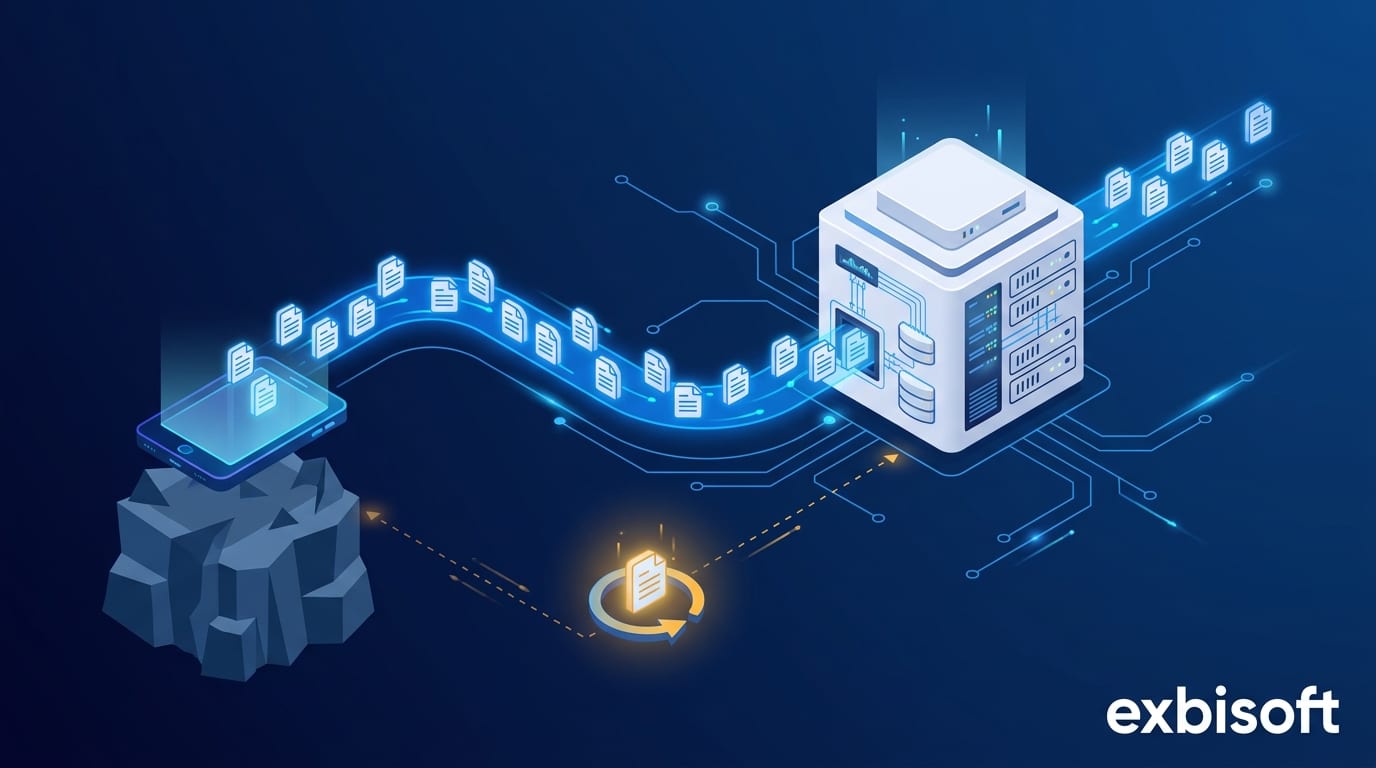
We built exactly this for a company whose field engineers create water-quality reports on site. The system, ReportSync, moves those reports from Excel into the company CRM over a secure tunnel — and it treats failure as a first-class scenario, not an exception:
- Every sync is logged — what was sent, when, to which record, and whether it completed. Delivery is provable, not assumed.
- Failures are visible — failed uploads appear in a dedicated iPad app, not in a log file nobody reads. A person can see, at any moment, what has not arrived.
- Recovery is one action — inspect the error, tap retry. No report is lost because a connection dropped at the wrong moment.
None of this is exotic engineering. It is a design stance: unreliable connectivity is the operating environment, so visibility and recovery are core features — not error handling bolted on at the end.
Why this is a support story, not just a build story
Here is the part that gets overlooked: a system like this proves its value over years, not at launch. Field devices get replaced. The CRM gets upgraded. Certificates expire. Each of these events can quietly break a sync pipeline — and then you are back to silent failure, just with better logging.
That is why ReportSync runs under Managed Support & Maintenance: someone is responsible, continuously, for the pipeline staying provable. For field systems carrying compliance data, that ongoing ownership is not an add-on to the product. It is the product.
If your field teams collect data that matters — and you cannot currently prove all of it arrives — that is a conversation worth having.