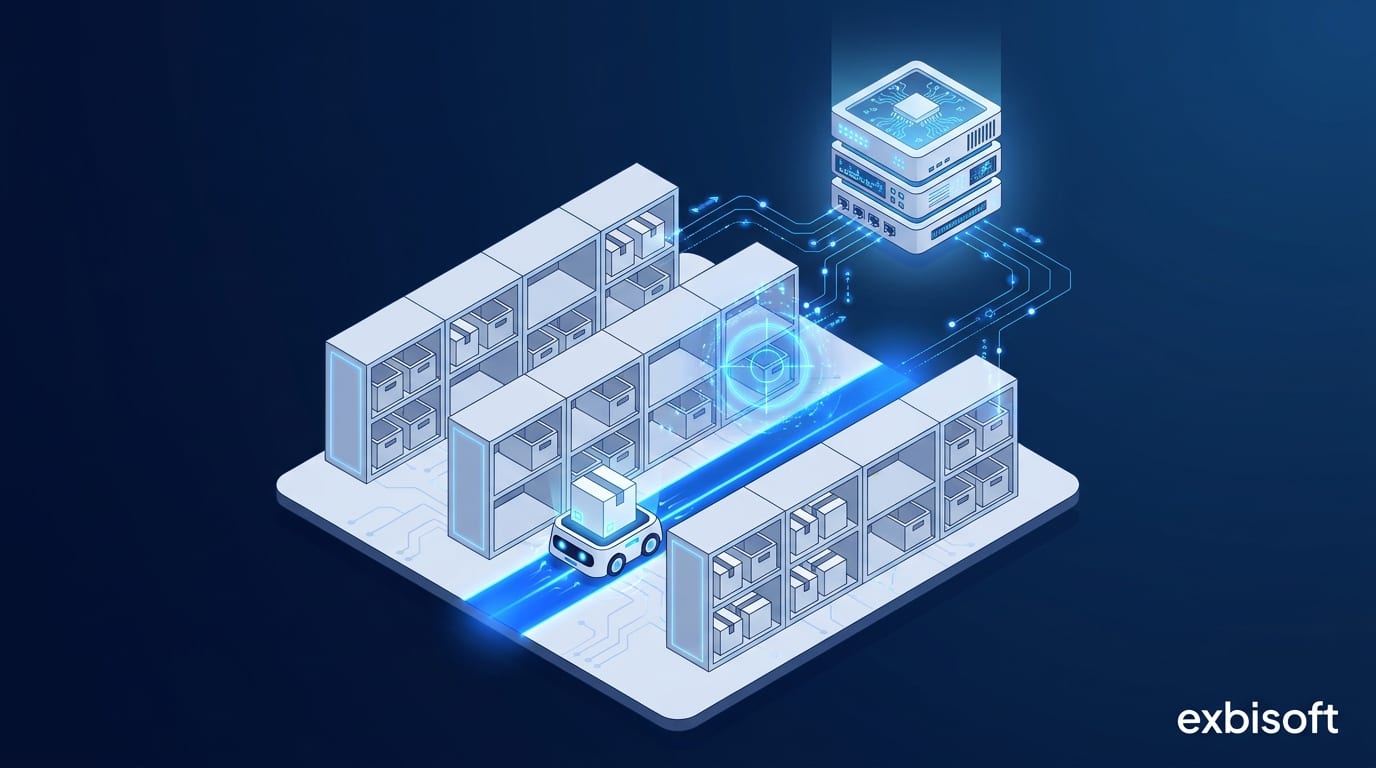
Photo: Google Gemini · AI-generated
New to this topic? Start here
Terms used in this piece
- Physical AI
- Software that senses the physical world and acts in it through a machine: a robot, a vehicle, a camera system.
- Intralogistics
- Everything that moves goods inside one site: receiving, storing, picking, packing and dispatch.
- Autonomous mobile robot (AMR)
- A robot that drives through a building on its own and finds its way around obstacles, without a fixed track.
- WMS (warehouse management system)
- The software that knows what is stored where, which orders are open and what has to be picked next. Sometimes it is part of the ERP.
- UDI (Unique Device Identification)
- A code on the label of a medical product that identifies the product and, depending on the product, its batch or serial number.
- Notified body
- An independent organisation appointed by an EU country to check whether a product meets EU rules before it may be sold.
Read first
- Beyond EDI: The Integration Work Manufacturers Actually Need to Connect ERP, WMS and PLMOur earlier piece on how ERP and warehouse systems pass data to each other. A robot is one more system on the end of that chain.
Most of the warehouse software we have built never touches a robot. It runs on a handheld scanner. For a software vendor that sells an add-on to Sage 100, we replaced a Windows CE warehouse app with a native Android one: receiving, stock movements, dispatch, production bookings. The new screens were not the hard part. The hard part was making sure every scan still became the right booking in the ERP, exactly as before, so the vendor’s customers could change their hardware without changing how their warehouse works.
We kept thinking about that project while reading about physical AI.
Physical AI is mostly not humanoids
In October AWS published a survey of 4,420 startups in 20 countries, run with Strand Partners. About one in seven of them builds physical AI: software that senses the physical world and acts in it. Only 12 percent of those builders work on humanoid robots. The rest build mobile robots, robot arms that work next to people, cameras and sensors. Germany has the highest share of builders in the survey, at 24 percent, and the main reason German customers adopt these systems is that they cannot find enough workers. In logistics, warehousing and retail, 47 percent of the builders already have systems in commercial use.
Two caveats. AWS sponsored the survey, and it asked the startups, not the companies that buy from them. Builders are optimistic by nature. That makes one finding more telling, because it comes from the optimists: only about one in four says their market is ready to deploy. And when asked which roles they will need, 48 percent name the systems integrators who install these machines and connect them to everything else.
The robot only knows what the system knows
A mobile robot can drive to bin C-14-03 and pick up a box. It cannot know whether the box in C-14-03 is the right one. That knowledge sits in the ERP or the warehouse management system: which order is open, what was booked into which bin, which batch is blocked, which label belongs on the parcel. If someone put stock away last week and booked it to the wrong bin, a human picker notices and goes looking. A robot goes to the wrong bin, quickly and every time.
So most of the work in a robotics pilot is not the robot. It is the interface between the robot’s fleet software and the systems that hold orders and stock: who sends the job, who confirms it, and what happens to the booking when a pick fails halfway through. Under that sits the data. For a medical device manufacturer we built the labelling system that prints warehouse bin labels and UDI labels from the product master data. Labels like these are what a robot’s scanner or camera reads. If the master data is wrong, the label is wrong, and the robot acts on it without hesitating.
We have not built software for a robot, and we are not going to pretend otherwise. We have built the layer underneath more than once. That is where we expect most pilots to slow down, and the hardware will rarely be the reason.
A date for the paperwork: January 2027
The report does not mention it, but buyers in the EU should know about it. The new EU Machinery Regulation applies from 20 January 2027. It has specific requirements for autonomous mobile machinery, including a supervisory function through which a person can monitor the machine and stop it. Machines and safety components whose safety functions rely on behaviour that keeps learning need an assessment by a notified body, not only the manufacturer’s own declaration.
Who counts as the manufacturer when a robot is built into an existing site is a question for lawyers. The practical point for the software is simpler. Keep records from the first pilot onward: which software version ran, what changed, what was tested. Building that history later is much harder than keeping it from the start.
The same question in a hospital
Some hospitals already use robots to move linen, meals and supplies. The rule is the same as in the warehouse. A robot can only bring the right item if the item data is right, and for medical products that starts with the UDI on the label. There is simply less room for error.
If a robot pilot is on your list for next year, start with a question that has nothing to do with robots: are the bin locations and stock bookings in your system right today? If the honest answer is “mostly”, that is the first project. Talk to us if you want someone to look at it with you.
Go further
- Regulation (EU) 2023/1230 on machinery ↗The EU occupational safety agency's short page on the new Machinery Regulation, with links to the full text.
- Mobile ERP case studyThe handheld warehouse app described at the start of this piece.
- API IntegrationHow we connect systems that are already running without replacing them.
Sources
- AI Gets Physical: The Global Startups Readiness Index, AWS, with Strand PartnersSurvey of 4,420 startups in 20 countries, sponsored by AWS. Source for every figure in the second section.
- Report: Physical AI Growing Faster Than Markets Are Ready to Deploy, The AI InsiderIndependent coverage of the same report.
- Regulation (EU) 2023/1230 on machinery products, Official Journal of the European Union
- Machinery Regulation: main changes from Annex I of the Directive to Annex III of the Regulation, CEN-CENELECLists the new requirements for autonomous mobile machinery and the supervisory function.
- Product risk radar: Machinery Regulation, Baker McKenzieApplication date and the machine-learning categories that need a notified body.